




Academy
Forex Trading Sessions Explained for Funded Account Traders

•
Sep 30th, 2026
•
10 min
read


TL;DR: Forex runs 24 hours a day, five days a week, through four sessions: Sydney (roughly 22:00 to 07:00 GMT, 5pm to 2am New York), Tokyo (00:00 to 09:00 GMT, 7pm to 4am New York), London (08:00 to 17:00 GMT, 3am to noon New York) and New York (13:00 to 22:00 GMT, 8am to 5pm New York), with GMT figures shifting an hour under UK or US daylight saving. The London and New York overlap (13:00 to 17:00 UK time, 8am to noon New York) is the deepest four hours of the day for EUR/USD, GBP/USD, USD/JPY and gold, while the hour around daily rollover at 22:00 GMT (5pm New York) is the thinnest, with the widest spreads. Asian hours favour AUD, NZD and JPY crosses, London drives EUR, GBP and CHF, and New York adds USD and CAD flow around 13:30 UK time data. For a funded trader with a daily loss limit, the question is not "when can I trade" but "when does a stop loss mean what I think it means", because a 10-pip spread spike at rollover can trigger a stop that should never have filled and count against a limit that ends the account.
You have a daily loss limit. Every pip you give back to a widened spread at 22:15 GMT counts exactly the same as a pip lost to a clean trade at 14:00 GMT.
That is why sessions matter more on a funded account. A retail trader who takes a bad fill in the dead hours loses some money. A funded trader who takes one may lose the account.
Why Forex Trading Sessions Exist in a 24 Hour Market
Forex has no central exchange. Banks and brokers in each financial centre trade during local business hours, and as one region closes the next opens, so the market runs from the Sydney open on Monday (Sunday evening in Europe) to the New York close on Friday.
Continuous does not mean uniform. Liquidity rises and falls with whichever region is active. High liquidity means tight spreads and readable swings. Low liquidity means wide spreads and price jumping between sparse orders. The same setup, lot size and stop distance carry different real risk depending on the hour.
Trade Forex Without Limits
Tradeify is built for forex traders who want clarity, consistency, and speed — not surprises.
Join Discord


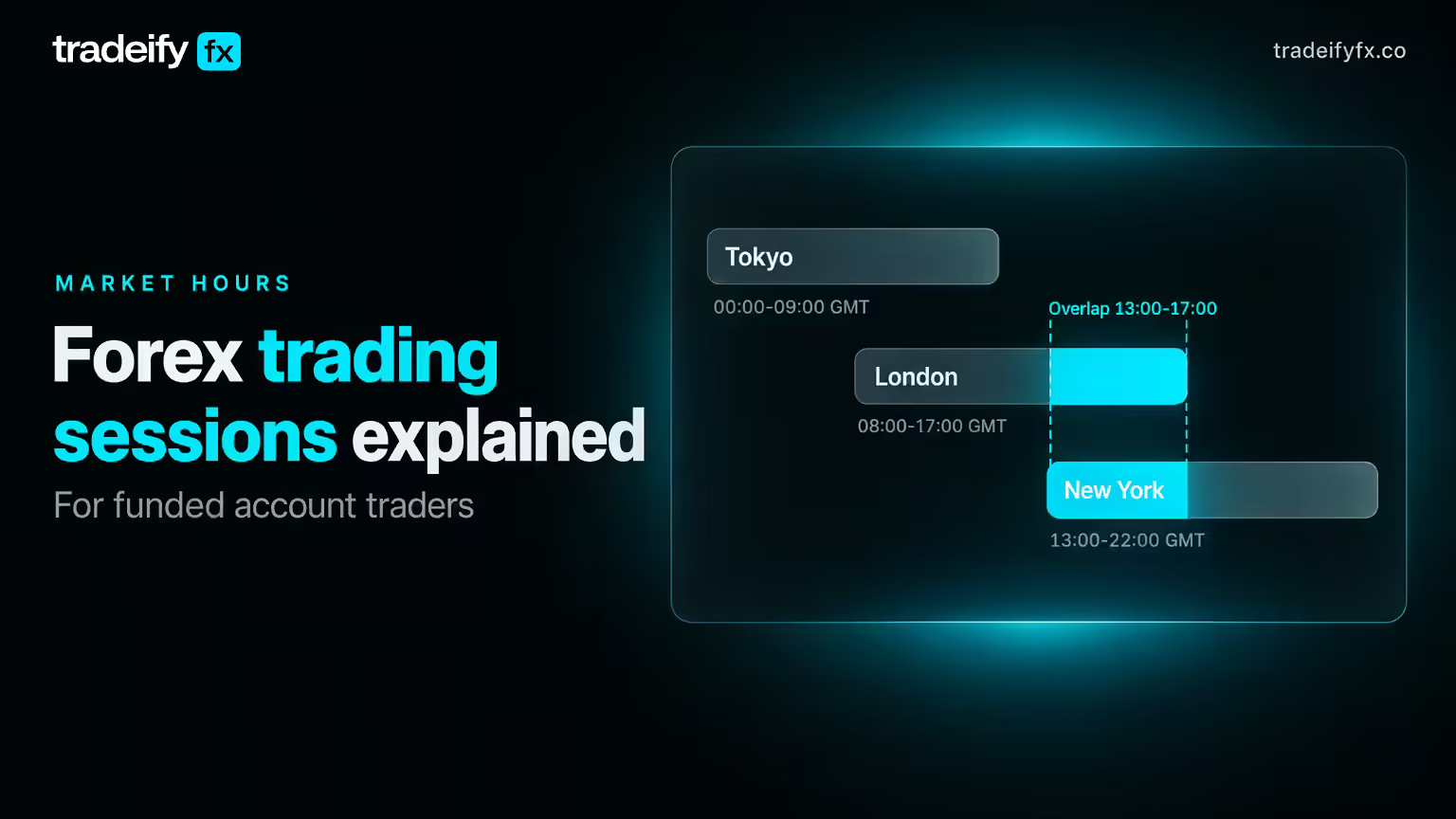
The Four Forex Trading Sessions in GMT and Local Time
Session times are conventions, and daylight saving shifts the GMT figures by an hour in the UK, Europe and the US on different dates. The table uses winter times. New York runs 13:00 to 22:00 UK time for most of the year, drifting to 12:00 or 14:00 for a few weeks around the clock changes. In New York time the four sessions run roughly 5pm to 2am (Sydney), 7pm to 4am (Tokyo), 3am to noon (London) and 8am to 5pm (New York), which is why many US-based guides quote session times in Eastern Time.
| Session | GMT (winter) | UK local time | Central European Time | Most active pairs |
|---|---|---|---|---|
| Sydney | 22:00 to 07:00 | 22:00 to 07:00 (23:00 to 08:00 in summer) | 23:00 to 08:00 | AUD/USD, NZD/USD, AUD/JPY |
| Tokyo | 00:00 to 09:00 | 00:00 to 09:00 (01:00 to 10:00 in summer) | 01:00 to 10:00 | USD/JPY, EUR/JPY, AUD/JPY |
| London | 08:00 to 17:00 | 08:00 to 17:00 all year | 09:00 to 18:00 | EUR/USD, GBP/USD, EUR/GBP, USD/CHF |
| New York | 13:00 to 22:00 | 13:00 to 22:00 most of the year | 14:00 to 23:00 | EUR/USD, GBP/USD, USD/CAD, USD/JPY, gold |
Sydney Session Trading Characteristics
Sydney opens the week with the lowest volume of the four sessions. AUD/USD, NZD/USD and their crosses move, especially around Australian data at 00:30 GMT. Everything else drifts, and EUR/USD or GBP/USD spreads can sit at two or three times their London width.
The funded-account risk is the Sunday open. Weekend gaps happen when news breaks while the market is closed, and no stop loss protects against a gap. Many evaluation traders simply do not hold into the weekend.
Tokyo Session Trading Characteristics
Tokyo brings in Japan, then Hong Kong and Singapore. Liquidity improves but stays well below London. USD/JPY and the yen crosses (EUR/JPY, GBP/JPY, AUD/JPY) carry the flow, while EUR/USD and GBP/USD often range inside 30 to 50 pips and Tokyo breakouts frequently retrace once London repositions.
The temptation for a European trader is to stay up and trade EUR/USD because the chart is open. If your strategy is built on London momentum, Tokyo is a different market, and you have no edge in it until you have tested one.
London Session Trading Characteristics
London is the largest forex centre by volume. When it opens at 08:00 UK time (3am New York), European banks, funds and corporates enter at once, and the Asian range is usually resolved within one to two hours. EUR/USD, GBP/USD, EUR/GBP, USD/CHF and gold see their first real directional push, with UK and Eurozone data at 07:00, 09:00 or 10:00 UK time as catalysts.
The open also frequently produces a false break through one side of the Asian range before the real move starts the other way, which is why many session traders let the first 30 to 60 minutes settle.
Worked example: EUR/USD spent Tokyo between 1.0830 and 1.0860. At 08:15 UK time it breaks to 1.0868, stalls, and by 08:45 it is back at 1.0845 and falling. A trader who bought the break at 1.0865 with a 15-pip stop is out. A trader who waited, sold 1.0840 with a stop above 1.0870 and a target at 1.0790, had a defined trade with a clear invalidation. Neither knew the direction in advance. One let London tell them.
New York Session Trading Characteristics
New York opens at 13:00 UK time (8am New York) for most of the year, and US data lands at 13:30, so the first half hour is often the most volatile of the day. Everything with a USD leg moves, plus USD/CAD around Canadian data in the same slot, along with gold, oil and US indices.
After London closes at 17:00 UK time, volume falls sharply and the late session (roughly 18:00 to 22:00 UK time) drifts and reverses as European positions are squared.
For a funded trader that late session is a trap dressed as opportunity. You have been at the screen since 08:00, you may be down on the day, and the chart still moves just enough to look tradable. This is where "one more trade to get back to flat" happens, with wider spreads and less follow-through than the trade you are trying to recover.
London and New York Overlap Trading Hours
From 13:00 to 17:00 UK time (8am to noon New York) both of the largest centres are open. This is the peak of the day.
- Tightest spreads on EUR/USD, GBP/USD, USD/JPY and gold, and the highest hourly range on the majors.
- US data at 13:30 and the London fix around 16:00 UK time, both of which can produce bursts of flow.
- Enough depth that a stop loss fills close to the level you set rather than several pips through it.
The cost is real volatility. A 40-pip move in five minutes on a data print is not unusual, which is fine if you sized for it and not fine if you sized for a quiet range and held into 13:30 blind. The overlap gives the cleanest movement and the fastest path to the daily limit if the trade is wrong.
The conversation happens live
Blog comments are too slow for forex. Join 12,000+ traders in our Discord to discuss this article, share charts, and debate the market in real time.

Liquidity and Spread Widening Across the Trading Day
Think of the day as three states rather than four sessions.
- Deep: London morning and the overlap. Spreads tight, moves directional, stops behave.
- Moderate: Tokyo and late New York. Spreads acceptable, moves smaller and reversal-prone.
- Thin: the hour either side of daily rollover at 22:00 GMT, plus the Sunday open and Friday close. Spreads can widen to several times normal and price can spike in ways that never show on a higher time frame.
At rollover (17:00 New York time) the trading day formally ends, swap is applied to open positions, and many liquidity providers briefly pull or widen quotes. A stop 12 pips away on GBP/USD can be hit by a spread that briefly reaches 8 or 10 pips even if the mid price barely moved.
Some prop firms restrict or discourage trading around rollover and other low-liquidity windows, because fills there do not reflect a fair market. Read your own firm's Trading Rules before assuming either way.
Session Based Trading Strategies for a Daily Loss Limit
- Define your trading window before the week starts. For a UK or EU trader, 08:00 to 11:00 and 13:00 to 17:00 UK time cover the best hours. Writing it down converts a judgement call at 19:30 into a rule you already agreed to.
- Match pairs to the session. EUR/USD, GBP/USD and euro crosses in London. Add USD/CAD and gold in the overlap. If you are awake for Tokyo, trade yen crosses or AUD, not cable.
- Size for the session. Example on a simulated 100,000 balance risking 1% (1,000): a 30-pip stop in the overlap allows roughly 3.3 standard lots on EUR/USD; a 45-pip stop for Tokyo noise allows roughly 2.2 lots. Same risk, different size.
- Flatten before rollover. If a trade has not reached its target by 21:30 GMT (4:30pm New York) and the plan did not allow an overnight hold, close it. Holding through rollover "to let it come back" is a hope, not a plan.
- Stop when the session ends, not when the limit is close. A daily loss limit is a ceiling, not a target. Two losses in London and 60% of the limit gone does not make the late New York drift the place to recover it.
- Check the calendar at the start of each session. Getting caught by 13:30 data is a process failure, not bad luck.
One failure mode to name honestly: a slow London morning with no setups, still flat at 15:00. Boredom, not loss, is now the pressure. The window rule protects the account here too. No setup in the window means no trade. Flat days are part of passing.
Forex Trading Sessions FAQ
What are the four forex trading sessions
Sydney, Tokyo, London and New York, named after the financial centre most active in each period. In GMT (winter) they run roughly 22:00 to 07:00, 00:00 to 09:00, 08:00 to 17:00 and 13:00 to 22:00. In New York time that is roughly 5pm to 2am, 7pm to 4am, 3am to noon and 8am to 5pm. Sydney and Tokyo together are often called the Asian session.
What session is forex in right now
From the UK: 08:00 to 13:00 is London alone, 13:00 to 17:00 is the overlap, 17:00 to 22:00 is New York alone, and 22:00 to 08:00 is Sydney then Tokyo. MT5 shows server time in Market Watch; check whether your broker's server runs GMT, GMT+2 or GMT+3 before trusting candle timestamps.
Can you make $100 a day with forex
Some traders do on some days, and no trader does every day. On a funded account the better question is whether that target fits your risk. If your daily loss limit is 3% of a simulated 50,000 balance (1,500), aiming for 100 a day at 1:1 reward-to-risk means risking about 100 per trade and needing one net winner per day. Plausible, never guaranteed. Chasing a fixed number after a loss is one of the fastest ways to breach a limit.
What is the 5-3-1 rule in forex trading
Pick five currency pairs, master three strategies, and trade at one consistent time of day. It maps neatly onto session trading: a UK trader might choose EUR/USD, GBP/USD, USD/JPY, EUR/GBP and gold, use a London-open failed break, an overlap pullback and a range fade, and trade only 08:00 to 17:00 UK time. Fewer decisions under pressure is worth more than any indicator on a funded account.
Next Step for Trading Sessions on a Funded Account
Open MT5, find the server time offset in Market Watch, and write down in your local time when London opens, when the overlap runs, and when rollover happens. Then decide your trading window for the coming week and write that down too.
Our Tradeify FX evaluation and funded accounts run on MetaTrader 5 with a simulated balance, so you can apply a session window rule under our Trading Rules without depositing or trading your own money. Our Classic and Direct plans carry a 3% daily loss limit, while the Daily 1-Step plan has no daily loss limit and uses a 5% trailing max loss instead.
Trading leveraged CFDs carries a high level of risk and is not suitable for everyone. Evaluation and funded accounts are simulated, and results are not indicative of live-market results. Nothing here guarantees passing, funding, profit or payout. The session table tells you when the market is deepest. Whether you trade well inside those hours is still on you.

Keep Reading
See all
Academy
Sep 30th, 2026
Pips, Pipettes, and Lot Sizes Explained for Funded Forex Accounts
Academy
Sep 30th, 2026
MT4 vs MT5 for Funded Forex Traders
Academy
Sep 30th, 2026